


European Regulation for the Transitions: the SUSTAIN-AI-REG Summer School is under way in Rome
Some 45 students from six European universities, together with LUMSA master's students and professionals from international organisations, are spending the week in Rome working on how to regulate the digital, green and demographic transitions.

Rome, 9 September 2026 — The Summer School "European Regulation for the Transitions" is currently taking place at LUMSA University in Rome. Organised by the Jean Monnet Centre of Excellence SUSTAIN-AI-REG together with the LUMSA research centre HURFuture (Human Relations for the FUTURE), and co-funded by the European Union. The initiative started with an online preparatory day held on 1 September, followed by an intensive in-person week in Rome from 7 to 11 September 2026.
The programme brings together in a single interdisciplinary format the three transformations that are reshaping European regulation — artificial intelligence, sustainability and demographic change — and asks a common question across all of them: how can rules be designed, tested and evaluated so that they actually work?
An international classroom
Around 45 students are taking part, coming from six partner universities: Universidad Católica San Antonio de Murcia, Universidad Francisco de Vitoria, Universidade Católica Portuguesa, Catholic University of Croatia, Örebro University and Hamburg University. They are joined by students of LUMSA's master's programmes — including the Erasmus Mundus European Master in Law and Economics (EMLE) — and by professionals from international organisations, among them the OECD.
The faculty is equally international, with speakers from LUMSA, the Centre for European Policy Studies (CEPS), the OECD, the University of Southern Denmark, the Universidad Francisco de Vitoria and the Italian Senate of the Republic. All sessions are held in English, and combine lectures with discussion-based and policy-focused work, case studies and direct exchange with the speakers.


A preparatory phase before Rome
The programme opened on 1 September with a virtual component: an introduction to Behavioural Law & Economics (M. Rizzolli, LUMSA) and an introduction to Better Regulation (N. Rangone, LUMSA), complemented by more than ten hours of asynchronous material for in-depth study. Participants therefore arrived in Rome with a shared analytical vocabulary, which allowed the in-person week to move quickly into substance. The group met informally on the evening of 6 September for a welcome kick-off dinner and pizza-making class, with participants and faculty together.
Five thematic days
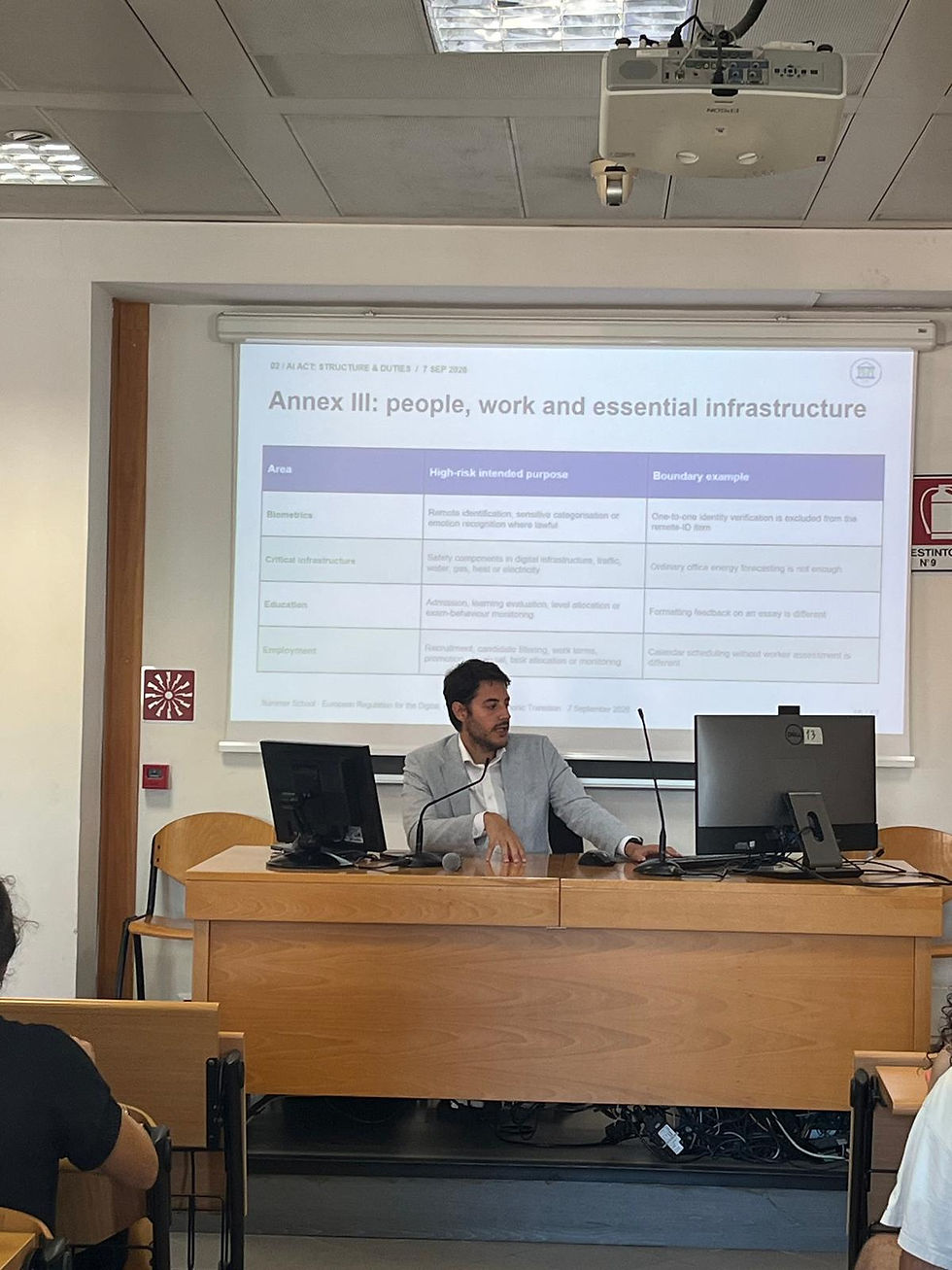
Monday 7 September — The three main challenges. The opening day framed the whole programme, moving from AI to the demographic transition: AI & Regulation: Where Do We Stand? (L. Megale, LUMSA), Green Transformation: Where Do We Stand? (G. Ferri, LUMSA) and Demographic Transition: Where Do We Stand? (M. Rizzolli, LUMSA).
Tuesday 8 September — AI and regulation: human decisions and innovation. The second day looked at how AI interacts with human judgement and with regulatory innovation: AI and Human Decisions: Cognitive Bias in High-Stakes Scenarios (A. Bogucki, CEPS), The Rule of Law, Fundamental Rights and Sustainable AI: The EU's Regulatory Framework for a Human-Centred Digital Transition (J. Regi Rodriguez, Universidad Francisco de Vitoria) and Regulatory Sandboxes (H. Shankar, OECD Consultant).
Wednesday 9 September — AI and green. Today's sessions address the two-way relationship between artificial intelligence and sustainability: Environmental Impact of AI (M. Naldi and P. Fantozzi, LUMSA), AI for Sustainability (A. Bogucki, CEPS) and Sustainable AI in Rules' Life-cycle (N. Rangone, LUMSA).
Thursday 10 September — Future generations. Organised by HURFuture, the fourth day turns to intergenerational justice: Why Future Generations Matter: An Introduction to Population Ethics (M. Rizzolli, C. Marcacci, LUMSA), Family Policies Through the Lens of Intergenerational Justice (M. Rizzolli, LUMSA), Intergenerational Justice in Aging Societies: Theory, Politics, and Policies (Pieter Vanhuysse, University of Southern Denmark) and Italy's Intergenerational Impact Assessment: A Case Study (Chiara Goretti, Italian Senate of the Republic).
Friday 11 September — Institutional visit. The week closes with an institutional visit to the National Council for Economics and Labour (CNEL), Viale David Lubin 2, starting at 9:45, giving participants a direct look at how consultation and advice feed into Italian rule-making.

Part of the Centre's mission
The Summer School is one of the teaching and outreach activities of the Jean Monnet Centre of Excellence SUSTAIN-AI-REG, directed by Prof. Nicoletta Rangone, which studies how artificial intelligence can support regulators and enforcement authorities while examining the implications for the rule of law, sustainability and the long-term responsibilities of the public sector. By connecting technology, sustainability, future generations and law-making in one programme, "European Regulation for the Transitions" gives a new generation of lawyers, economists, political scientists and technologists a comparative and forward-looking perspective on European regulation.


Comments